
Where a White Foldaway Washing Line Looks Best (And Where It Does Not)
White is the finish most people picture when they think washing line. It is also the one that gets chosen by default, which is a pity, because white is genuinely excellent on some walls and rather awkward on others.
The difference is easy to spot once you know what to look at.

Start with your window frames
South African aluminium window and door frames come in a standard palette. White, bronze, charcoal and natural anodised silver. Our wall-mounted foldaway comes in white, charcoal and bronze, so in most cases the answer is already on your house.
Walk outside. Look at the frame of the window nearest to where the line will go. If it is white, you have your answer and you can stop reading. White frames usually mean white gutters, white fascia boards and white burglar bars too, and your washing line will slot straight into that.

Where white is the right call
Indoors, first and foremost. Sculleries, laundry rooms, garages, bathrooms and enclosed back passages are almost always painted white or off-white, with white ceilings and white skirtings. A white foldaway reads as part of the fittings rather than an object bolted to the wall. Folded flat, most people do not notice it at all.
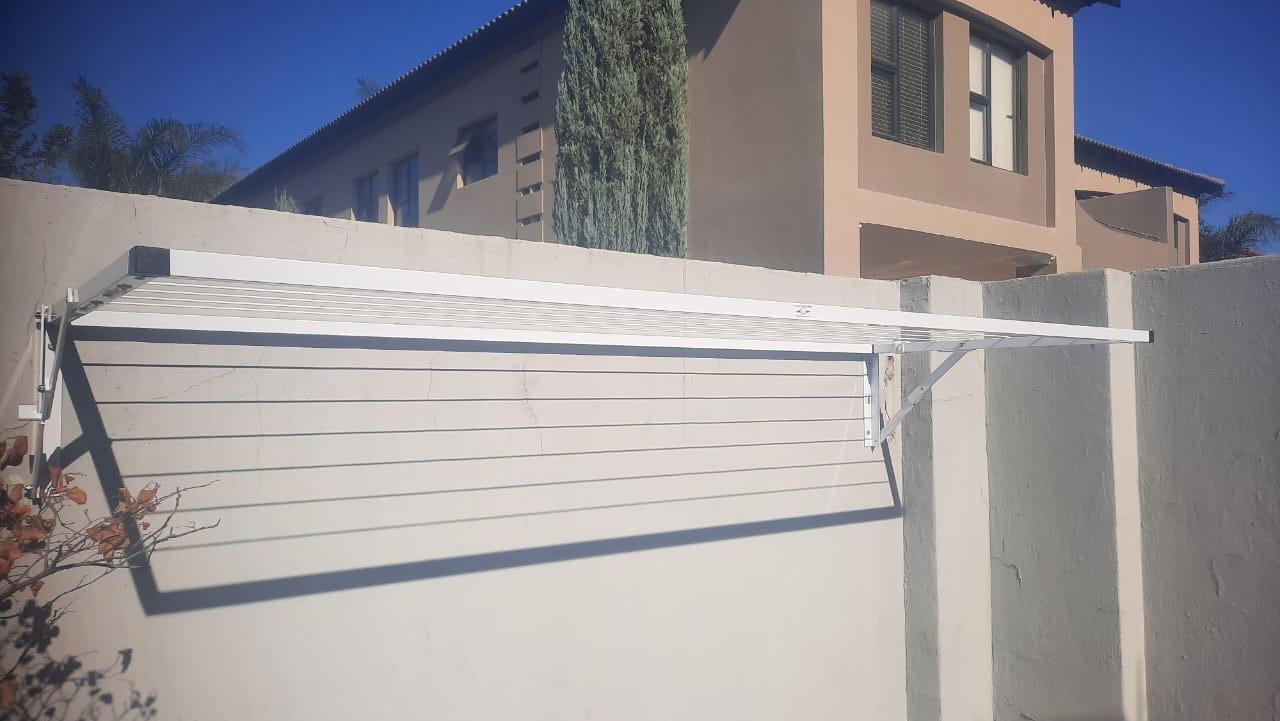
Outdoors, white belongs on light walls. Chalk, magnolia, cream, oyster, bone, soft grey, anything in that pale plaster family. The line goes quiet and your eye moves on to the garden.
Indoor sculleries, laundries, garages and enclosed back passages.
White, cream, off-white and pale grey plaster walls.
White aluminium window and door frames, white gutters and white burglar bars.
Covered patios, stoeps and lapa areas with white-painted beams or ceilings.
Coastal and Cape-style homes with lime-washed walls, white shutters and white pergolas.
Sandstone, travertine and light stone cladding, where white keeps things soft.
Complexes and estates where the body corporate specifies white for anything fixed to an external wall. Check your rules before you order, because white is usually the finish already on the approved list.

Where white foldaway washing lines doesn't work too well
Red and brown face brick is the big one. Brick is a warm mid-tone with a lot of texture, and a white line sitting on it is a bright, hard-edged object against a busy background. Your eye goes to the washing line before it goes to anything else in the garden. If your walls are face brick, charcoal or bronze will serve you far better.
Dark walls have the same problem in reverse. On charcoal plaster, dark cladding or black-painted brick, white draws a bright line across the wall.
Bronze or wooden window frames are worth a mention too. White next to bronze tends to look accidental rather than chosen, as though the line came from a different house.
And then there is dust. This is not a durability issue; it is a wiping issue. On the Highveld in winter, near a dirt road, or anywhere close to a building site, a white finish shows the fine red film that settles on everything. A charcoal or bronze line hides it. Warm soapy water and a cloth sort it out either way, you will just reach for the cloth a little more often with white.

Where white works like a charm
A white foldaway washline is the most harmonious choice for a variety of settings, blending in rather than standing out. Based on design principles and customer feedback, here are the prime locations for a white foldaway washing line.
Indoor Laundry Rooms: White is the undisputed champion for indoor spaces. It aligns perfectly with the crisp, clean aesthetic we often seek in our laundry areas. Whether your laundry room is a dedicated space or a modern multi-purpose area, a white line will feel like a seamless, built-in feature.
Modern Scandi or Minimalist Décor: If your home features a neutral palette with whites, greys, and light woods, a white washline is the obvious choice. It contributes to the minimalist, functional design by 'disappearing' into the background.
Light-Coloured Walls: A white line blends beautifully against white, off-white, or pastel-coloured walls. It avoids creating a stark visual contrast and instead becomes a subtle, integrated part of the room.
Covered Patios & Bright Balconies: For outdoor areas with a lot of light, a white line won't absorb heat in the same way as darker colours. It also visually recedes, keeping the focus on your outdoor living space rather than the laundry utility.

Contrast on purpose is a different thing
There is a version of white on a dark wall that looks superb, and that is when it is clearly deliberate. Think a modern farmhouse look, dark charcoal walls with crisp white trim, white door frames and white light fittings. If white already appears elsewhere on that wall, a white washline joins the colour scheme instead of interrupting it.
The test is simple. Stand where you will stand every day and ask whether the white washing line is repeating something or introducing something. Repeating is good. Introducing is usually not.

Three questions that nail it down
If you are still going back and forth, answer these in order and stop at the first clear yes.
Is the line going indoors, in a scullery, laundry, garage or enclosed passage? Order white. Indoors, white wins almost every time.
Are your window frames white? Order white. Your gutters, fascias and burglar bars are almost certainly white too, and the line will disappear into a scheme that already exists.
Is the wall itself light, in the cream, chalk, oyster or pale grey family? Order white. It will go quiet and stay quiet.
If all three are no, white is probably not your finish. Charcoal is the safest alternative, and bronze is the right call if your house leans warm.
One small practical advantage
Light surfaces absorb less heat than dark ones. A white washline on a west-facing wall in summer stays cooler to the touch than a charcoal or bronze one at the same time of day. If the washing line is at child height, or you are hanging washing in the middle of the afternoon, that is a real and pleasant difference.
Not sure which wall you have?
Send us a photo on WhatsApp. Stand back far enough to catch the window frames, the wall finish and the paving in one shot, and we will tell you what we would put up there. We do this all day, and we would rather you loved it in year three than picked the safe option in week one.
White foldaway: quick match guide
What is on your house | Verdict | Why |
Indoor scullery or laundry | Strong match | Blends with white walls, ceilings and fittings |
Cream, white or off-white plaster | Strong match | Sits quietly, eye moves past it |
Warm beige plaster | Strong match | Light on light, soft and unfussy |
White aluminium frames | Strong match | Same finish as your frames, gutters and fascias |
Sandstone or travertine cladding | Strong match | Keeps the palette light and calm |
Grey plaster or grey face brick | Works, with care | Reads as contrast, fine if repeated elsewhere |
Charcoal aluminium frames | Works, with care | High contrast, make it look deliberate |
Terracotta roof tiles | Works, with care | Only if the walls are light too |
Red or brown face brick | Not its best wall | Bright object on a warm textured background |
Bronze aluminium frames | Not its best wall | Cool white beside warm bronze looks unplanned |
White foldaway: Colour-match Chart

Foldaway Colour Comparison Table
Finish on your house | White | Charcoal | Bronze |
Red or brown face brick | No | Yes | Yes |
Grey face brick | Care | Yes | No |
Cream or white plaster | Yes | Yes | Care |
Warm beige or ochre plaster | Yes | Yes | Yes |
Grey or charcoal plaster | Care | Yes | No |
Sandstone or travertine | Yes | Yes | Yes |
Timber deck or cladding | Care | Yes | Yes |
Thatch or lapa | Care | Yes | Yes |
White aluminium frames | Yes | Yes | Care |
Charcoal aluminium frames | Care | Yes | No |
Bronze aluminium frames | No | Care | Yes |
Terracotta roof tiles | Care | Care | Yes |
Charcoal roof or grey pavers | Care | Yes | Care |
Indoor scullery or laundry | Yes | Care | Care |


Comments